

If there is one single mistake I see more often than any other, it is this: paying too much, too early.
Not because the contractor is malicious. Not because the work is substandard. But because the payment schedule in the contract—or the lack of one—leaves the homeowner with no leverage when something goes wrong.
I have sat across from retirees who paid 50% upfront, only to watch the contractor show up for two days, disappear for three weeks, and then demand another payment before returning. I have read contracts where the final payment was due before the final inspection—meaning the homeowner paid in full before the city even signed off on the work. And I have reviewed disputes where the homeowner had paid 90% of the project cost but only 60% of the work was complete.
Here is the problem: once you pay, your leverage disappears. The contractor has your money. You have their promise. And promises are much harder to enforce than payments.
Let me walk you through what a safe payment schedule looks like, why it protects you, and what I wish every retired homeowner knew before they signed a contract.
Why Retired Homeowners Are Especially Vulnerable
Retirement changes the financial dynamic of a home remodel. You may be living on a fixed income. You may have saved for years for this project. You may be paying from savings or a home equity line of credit.
And because you have the money available—because you are not financing through a bank that requires inspections and draw schedules—you are a target.
Contractors know that retired homeowners often have:
Cash available for deposits and progress payments
Less experience with large-scale construction projects
A desire to trust the professionals they hire
Reluctance to complain or demand accountability
That does not make every contractor a predator. But it does mean you need to be more careful, not less. A payment schedule that works for a 35-year-old with a flexible budget is not necessarily safe for a 70-year-old on a fixed income.
The Most Common Dangerous Payment Schedules
Here are the payment schedules I see most often—and why each one is a red flag.
Schedule 1: 50% Down, 50% at Completion
Milestone | Amount |
|---|---|
Signing | 50% |
Completion | 50% |
Why it is dangerous: You have handed over half the project cost before a single hammer swings. If the contractor disappears, gets sick, or goes bankrupt, you have lost 50% of your money. And if the work is substandard at the end, you have only 50% left to withhold—which may not be enough to cover the cost of fixing the problems.
Schedule 2: 30% Down, 30% at Demo, 30% at Rough-In, 10% at Completion
Milestone | Amount |
|---|---|
Signing | 30% |
Demolition complete | 30% |
Rough-in complete | 30% |
Completion | 10% |
Why it is dangerous: This schedule looks reasonable at first glance. The problem is the 10% final payment. That is not enough leverage. If the project is 90% complete and you are unhappy with the work, the contractor has little incentive to return and fix issues. They already have 90% of their money. The remaining 10% is not enough to motivate them.
Schedule 3: 100% Due Before Final Inspection
Milestone | Amount |
|---|---|
Completion (before final inspection) | 100% |
Why it is dangerous: This is the worst of all. You have paid in full before the city has inspected the work. If the inspection fails, the contractor has no financial incentive to return and fix the problem. You are left paying for repairs out of your own pocket.
The Payment Schedule I Recommend

After reviewing hundreds of contracts, I have seen payment schedules that work and payment schedules that fail. Here is the structure I recommend for older homeowners.
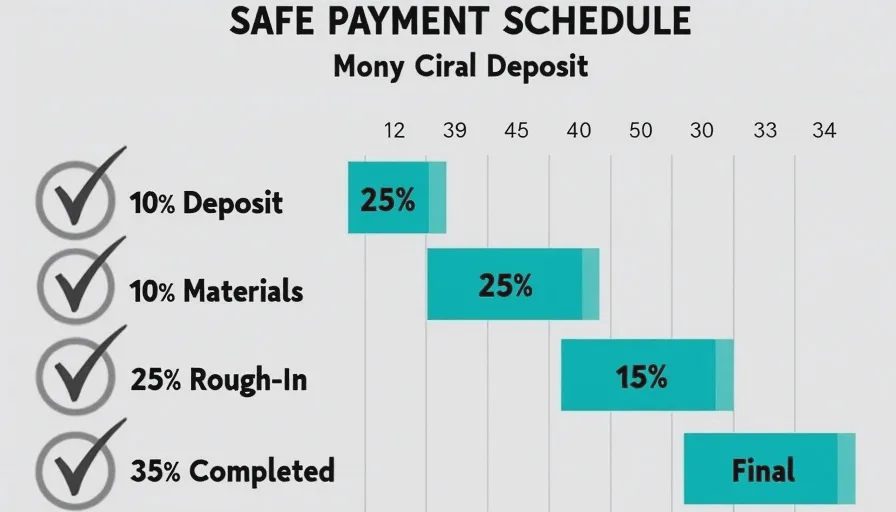
The Safe Schedule
Milestone | Amount | What It Requires |
|---|---|---|
Signing | 10% | Contract signed, permit application filed |
Materials delivered | 25% | Materials are on site and verified |
Rough-in passed inspection | 25% | Framing, plumbing, electrical approved by city |
Substantial completion | 25% | Work is complete except punch list items |
Final inspection and punch list complete | 15% | Final inspection passed, all punch list items done |
Why This Schedule Works
10% at signing is enough to hold your place on the contractor's schedule and order materials. It is not so much that you cannot walk away if the contractor fails to perform.
25% at material delivery ensures the contractor has actually purchased the materials and they are physically present. You can see them. You can verify the brand and quality match the contract.
25% at rough-in pass ties payment to a verifiable milestone—the city inspector's approval. The rough-in is when the electrical, plumbing, and structural elements are inspected. This is the most critical phase of the project.
25% at substantial completion gives the contractor incentive to finish the visible work, but leaves enough remaining to address issues.
15% at final inspection and punch list is the leverage you need. The contractor cannot walk away with full payment until the city has signed off and you have walked the job and confirmed everything is complete.
The "No Payment Without Progress" Rule

Here is a simple rule I give every homeowner I work with:
Never pay for work that has not been completed.
That sounds obvious, but it is violated constantly. A payment schedule that ties payments to calendar dates (e.g., "Week 1: X,Week2:X,Week2:Y") is not a protection. It is a payment plan. It guarantees the contractor gets paid regardless of progress.
Instead, every payment should be tied to a visible milestone:
"When the walls are open and plumbing and electrical rough-in is complete"
"When the drywall is hung and taped"
"When the cabinets are installed and the countertop template is done"
"When the final inspection is passed"
If the milestone is not achieved, the payment is not made. That is how you protect yourself.
The Subcontractor Problem
Here is another layer that most homeowners do not think about.
Your general contractor pays subcontractors—plumbers, electricians, tilers—from the progress payments you make. If you pay the GC on time, they are supposed to pay the subs on time. But sometimes they do not.
If the GC does not pay a subcontractor, that subcontractor can file a mechanic's lien against your home. Even though you paid the GC in full, the sub can still come after your property for their unpaid labor.
That is why I recommend a variation of the safe schedule that protects you from this risk:
Hold the final 15% until the GC provides a conditional lien waiver from every subcontractor and supplier.
A lien waiver is a document that says the subcontractor has been paid and gives up the right to file a lien. Without it, you are at risk of paying twice.
What to Avoid: The Trap of "We Need Money for Materials"
One of the most common contractor requests is to increase the deposit or progress payments because they "need money to buy materials."
Here is the reality: a legitimate contractor has a line of credit with their suppliers. They do not need your money to order materials. They order materials on credit, install them, and pay the supplier from your progress payments.
If a contractor asks for 50% or more upfront "to buy materials," they are either:
Under-capitalized (they do not have enough cash to run their business)
Using you as a bank (they are borrowing your money interest-free)
Neither is a reason to increase your risk.
The Conversation You Need to Have

Before you sign any contract, sit down with the contractor and have this conversation:
"I want to make sure we are both protected. I am comfortable with the safe schedule—10% at signing, 25% on material delivery, 25% on rough-in pass, 25% at substantial completion, and 15% after final inspection and lien waivers. If that works for you, we can sign today. If you need a different schedule, I would like to understand why."
A reputable contractor will agree to this schedule without hesitation. They understand that protecting the homeowner's cash is part of good business. A contractor who pushes back—who says "we need more upfront" or "we cannot work with that schedule"—is telling you something important about how they operate.
Believe them.
My Rule for Older Homeowners
The payment schedule rule I wish more retired homeowners knew is simple:
Never let your payments get ahead of the work.
Hold the final payment until the job is complete, the final inspection is passed, and you have lien waivers in hand. That final payment is your only leverage. Do not give it up early.
A contractor who respects you and their trade will not ask you to. And you should not agree to.